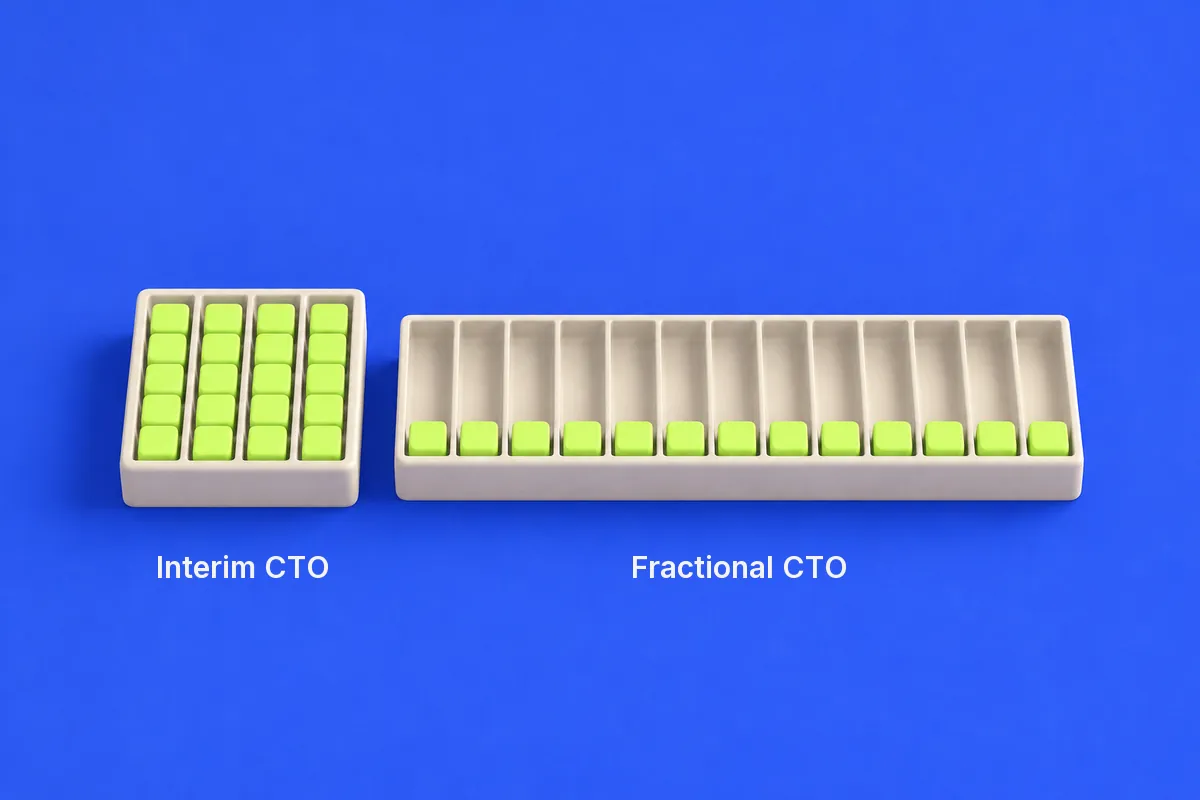
Most startups don’t need a full-time CTO before they have a product and paying users. What they need is a fractional CTO (one experienced person who makes the technical decisions for 10 to 40 hours a month) and a team that can build. A full-time CTO costs $250,000 to $400,000 or more a year and takes 3 to 6 months to hire, by JetRockets’ estimate (JetRockets). That spend makes sense once you have engineers who need a leader every day.
Do you need a CTO? The short answer by stage
Stage
What you need on the tech side
Full-time CTO?
Idea, nothing built
Someone to check your plan, your budget and the quotes you get
No
Building the first release
One person who makes the tech decisions, plus a team that builds
Usually not
Live, first paying users
Releases every week or two, and someone watching cost, speed and security
Not yet
Raising a round
Clear answers to investors’ tech questions and code that passes a review
Not always. Part-time help can cover it
Several in-house engineers, and the tech is your edge
A leader for that team every day
Yes
Do you need a full-time CTO at your stage?
The CTO’s job grows with the team. With no engineers there isn’t much to lead, and once you have several, leading them is a full-time job.
What a startup CTO does at each stage
Before you build, a CTO turns your idea into a plan: what goes into the first version, what waits, which tech to use and roughly what it costs. They also read developer quotes and tell you which ones make sense.
During the first release, they make the calls that are expensive to undo later, like how logins and payments work, where the data lives and which AI setup to use. They check the team’s work every week.
After launch, the job is steady releases, fixing what breaks and watching what the product costs to run per user. Security, backups and access to accounts are on them now.
When you raise money, investors ask who owns the tech and whether the code holds up. The CTO answers and gets the company ready for technical due diligence.
Once the team grows, they hire engineers, set the bar for code quality and run the team. That’s when the job fills 40 hours a week. Before then it often doesn’t. CTO coach Stephan Schmidt writes that at seed stage there often isn’t 40 hours of CTO work a week (Amazing CTO).
Five ways to get a CTO, compared
Option
What it costs
What you commit to
Equity
Best for
Full-time CTO
$250,000-400,000+ a year (JetRockets)
A senior salary, and 3-6 months to hire
Usually, on top of salary
A team of engineers that needs a daily leader
Technical co-founder
Equity instead of a full salary
Years of working together
Yes, often close to half in a two-founder team
You’ve found the right long-term partner
Interim CTO
$25,000-50,000+ a month (Amazing CTO)
Full-time, typically for 3-6 months
Usually no
Your CTO left, or a project is in trouble
Fractional CTO
$390-2,200 a month for 10-40 hours (Rocketech)
A monthly package of hours
No
Startups before product-market fit
Agency in the CTO role
The price of the build, e.g. $5,000-15,000 for an MVP (Rocketech)
A project or team contract
No, or a small stake in a co-founder deal
You need the product built and the tech decisions made
Five ways to get technical leadership for a startup
Full-time CTO
A full-time CTO is an employee with a salary and, usually, stock options. They’re worth it when there’s a team to run. Before that, you’re paying a senior salary for work that doesn’t exist yet. Hiring takes months, and a wrong hire at this level costs you more months.
Technical co-founder
A co-founder costs no cash up front. They cost a share of the company. Among two-founder startups on Carta, the median split was 51-49 in 2024, and 45.9% of two-founder teams split their equity equally (Carta). If the company does well, that share is the most expensive line in this table. It’s still the right call when you’ve found someone you want to build with for years. If you can’t find that person, a team can take the technical co-founder seat instead.
Interim CTO
An interim CTO is a full-time CTO for a few months, typically 3 to 6, brought in when the CTO leaves or a launch goes badly. Amazing CTO puts the cost at $25,000 to $50,000 or more a month. A startup with no engineers yet would be paying that for a role that’s mostly about leading people.
Fractional CTO
A fractional CTO is a senior technical leader who works for you part-time, for a set number of hours a month, instead of as a full-time executive. “Fractional” means you pay for a fraction of a full-time role. They make the technology decisions and check the team’s work, without a full-time salary or equity.
You keep them for as long as you need them. With us, a fractional CTO costs $390 to $2,200 a month. That’s 10, 20 or 40 hours at $39 to $55 an hour, with no equity. Amazing CTO puts the wider market at $6,000 to $20,000 a month for one or two days a week. The trade-off: a part-time CTO isn’t there every day, so they can’t lead an in-house team day to day.
The three packages add up like this:
Package
Price a month
How we count it
10 hours a month
$390-550
10 hours at $39-55
20 hours a month
$780-1,100
20 hours at $39-55
40 hours a month
$1,560-2,200
40 hours at $39-55
Fractional CTO cost at Rocketech, by package
An agency in the CTO role
Some agencies, us included, cover the CTO role while they build. You get the tech decisions and the team under one contract. Watch for one risk: an agency earns more when you build more, so ask who on their side will tell you not to build something.
In a co-founder deal with us, part of the fee can be a small equity stake and the rest is paid in cash. Our stake gets diluted like everyone else’s when you raise money. Our page on engagement models compares this with fixed-price and hourly work.
Subflare is one example of an agency in the CTO role. Its founder had an idea and a Figma file for B2B lead-scoring software but no team, and hired us as his CTO and dev team instead of giving away equity to build one. We tested the risky AI part in 2 weeks, then built the product, and in January 2026 the MVP was approved for client onboarding.
Interim CTO vs fractional CTO: which one?
Founders mix the two up because both are temporary in some way. They differ in hours and in purpose.
Interim CTO
Fractional CTO
Hours
Full-time
10-40 hours a month with us
How long
Typically 3-6 months
Ongoing, as a monthly package
Main job
Fill an empty CTO seat and steady the team
Make the tech decisions and check the work
Pick it when
Your CTO left or a release is in trouble
You don’t have a team to lead yet
Interim CTO vs fractional CTO
If you have no CTO and no in-house engineers, you want the fractional option. Interim makes sense when a team has lost its leader.
When you don’t need a CTO yet
Hold off on any kind of CTO if:
You haven’t checked that people want the product. Talk to customers and try to pre-sell first. Our guide on how to validate a startup idea shows how to do it without code.
The first version can run on a no-code tool or software you can buy. A simple booking site doesn’t need a CTO.
You mostly want a CTO for the team slide in your pitch deck. Investors will ask what that person does all week.
Your budget covers advice or building, not both. Then spend it on MVP development from a team that makes the tech decisions as part of the job. Our MVP cost guide shows where the money goes.
You have several engineers in-house who need a leader every day.
The technology is what sets you apart, such as your own AI models or hardware.
You handle health, financial or other sensitive data and need one person accountable for security.
The investors in your next round expect a full-time technical leader on the team.
How to hire a CTO, step by step
Write down what the CTO has to get done in the next 12 months, such as shipping a first release or getting ready for a round. That tells you whether the job is full-time or part-time.
Look in your network first: former colleagues, founders you know, engineers who’ve shipped something like your product. If you want a co-founder, Y Combinator runs a free co-founder matching platform.
Ask how they’d approach your product. A good candidate asks about your customers before talking about tech.
Pay for a test project of a week or two, such as a plan and estimate for your first release, or a review of code you already have.
Call people who worked with them, especially engineers who reported to them.
Put any equity on a vesting schedule, so it’s earned over time instead of handed over on day one.
Red flags to watch for:
They want to rebuild everything before looking at it.
You can’t follow their explanation of a technical choice.
Nothing they’ve built has reached real users.
Their tech picks follow what they enjoy, whether or not it fits your product and budget.
When part-time help is enough: two apps we launched
EasySpk and GhostMinutes started the same way. Each founder came to us with an idea and nothing built. We worked as their fractional tech co-founder: we planned a first release that fit into 2 weeks, chose the tech, built the app and ran the launch.
EasySpk is an AI voice keyboard for iPhone. It went from a name to the App Store in 2 weeks and got 1,000+ downloads in its first days. After launch, the team moved to 1-week sprints.
GhostMinutes turns meetings into notes. The iOS app shipped in 2 weeks and the web app 1 week later. After pricing tests with the founder’s marketing team, it reached $1,500 in monthly recurring revenue.
Both apps launched on our Apple developer and Stripe accounts, so the founders didn’t have to wait for their own accounts to be approved. Our guide on how long it takes to build an app explains what fits into 2 weeks and what doesn’t. If your product runs on AI, how to start an AI startup covers the rest of the path.
Getting ready for technical due diligence
Before a round, investors or their advisers may look at your tech. The review goes better when:
The code lives in a repository your company controls, and every developer contract transfers the code to the company. Our intellectual property checklist lists what to check.
You know who holds admin access to the cloud, the domain, the app stores, payments and analytics, and you can log in to each.
A one- or two-page overview explains how the product is built and why.
Passwords and keys are kept out of the code, backups have been tested, and you can cut off access when someone leaves.
There are tests, and someone other than the person who wrote the code can ship a release.
You know what the product costs per active user, AI requests included. Our guide to what an AI app costs breaks this down.
Not always, and rarely full-time at the start. Before you have a product and a team, you need someone who owns the technical decisions, and a part-time CTO or a partner team can do that. A full-time CTO makes sense once you have several engineers to lead or your technology is what sets you apart.
What is a fractional CTO?
A fractional CTO is a senior technical leader who works part-time, for a set number of hours a month. They choose the tech stack and architecture, plan the first release, check estimates and code from other teams, and get the company ready for investors’ technical questions. You get a senior person for technical decisions without paying a full-time salary or giving away equity.
How much does a CTO cost for a startup?
A full-time CTO costs $250,000 to $400,000 or more a year by JetRockets’ estimate, usually plus equity. An interim CTO runs $25,000 to $50,000 or more a month by Amazing CTO’s estimate. A fractional CTO from Rocketech costs $390 to $2,200 a month for 10 to 40 hours. A technical co-founder usually takes equity instead of a full salary.
How much does a fractional CTO cost?
At Rocketech, $390 to $550 a month for 10 hours, $780 to $1,100 for 20 hours and $1,560 to $2,200 for 40 hours, all at our public rate of $39 to $55 an hour. Amazing CTO puts the wider market at $6,000 to $20,000 a month for one or two days a week.
What is the difference between an interim CTO and a fractional CTO?
An interim CTO works full-time for a few months, usually to fill an empty CTO seat or steady a team. A fractional CTO works part-time, a set number of hours a month, for as long as you need. Interim fits a company whose team has lost its leader. Fractional fits a startup that doesn’t have an engineering team yet.
How much equity does a technical co-founder get?
It depends on what each founder puts in: time, money, skills and risk. Carta’s data shows the median split in two-founder startups was 51-49 in 2024, and almost half of those teams split equally. A CTO hired later usually gets a smaller stake that vests over several years.
Can a non-technical founder raise money without a CTO?
Yes, but investors will ask who builds the product and who owns the tech. Have a clear answer ready, such as a fractional CTO or a partner team with a plan and a budget. They’ll also want evidence that customers want the product.
When should a startup hire a full-time CTO?
When the work fills the week. That usually means several engineers need daily leadership, or the technology itself is your edge. For many startups that comes after they find product-market fit or raise a seed round.
Find out what tech help you need
Tell us what you’re building and how far along you are. We’ll say whether you need a CTO now, part-time help or only a team to build the first release. You can also start with a free project estimate to see what your first version would cost.