Your Vibe-Coded App Works. Is It Ready for Real Users?
Nine things to check before strangers sign up and pay, how to test each one yourself, and how to decide whether to keep, fix or rebuild what the AI wrote.

How to build a startup as a non‑technical founder? It’s one of the most common questions in pre-development, early‑stage SaaS startups. Investors want to know if you can lead the business without writing code, and how you’ll manage the risks that come with hiring technical leadership.
A strong non‑tech founder investor pitch doesn’t depend on pretending to be an engineer but on showing that you understand the market, the economics of SaaS, and how technology decisions connect to business outcomes.
That’s where the role of CTO in a SaaS business becomes central. Investors look for clear CTO collaboration with non‑technical founders — proof that you and your technical lead work as a team, share responsibility, and make startup decisions together.
This article builds a five‑step strategy to help non‑technical founders pitch with confidence, address investor concerns directly, and show that hiring a CTO was a smart, deliberate move.

Non‑technical SaaS founders can pitch with confidence by showing they understand business strategy and collaborate effectively with their CTO.
5 steps:
The result: Investors see resilience, clarity, and a smart founder who can successfully pitch your SaaS without writing code.
When investors meet a non-technical founder with a hired CTO, they usually see three main risks.
These concerns matter even more in B2B SaaS products. The technical decisions your CTO makes directly shape profit margins, customer acquisition payback periods, and scaling ability. A solid technical foundation can mean the difference between smooth growth from 100 to 1,000 customers or burning through cash on infrastructure.
The biggest mistake is treating your CTO as a translator who simply “handles the tech.” If you defer every technical question, investors assume you don’t understand your own business. What they expect is not coding skills but technical literacy — enough knowledge to make informed decisions and show that you are in control.
Let’s break down exactly how to structure your approach when communicating with investors as a non-tech founder and pitching with a hired CTO.
Related articles:
Before You Build: A Founder’s Guide to B2B SaaS Financial Models
The Ultimate Guide to Building a B2B SaaS Financial Model for Startup Founders
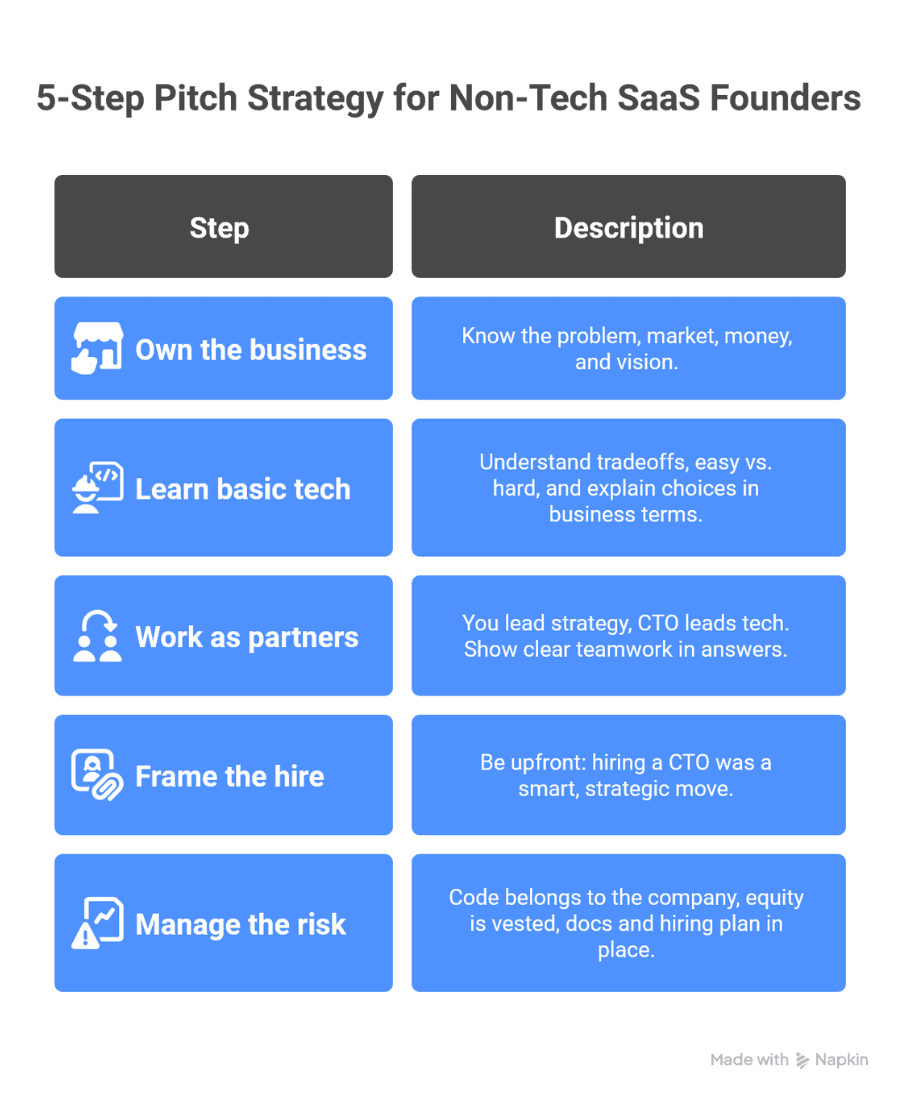
Investors expect you to lead on the market, the problem, the business model, and the vision. This is your role, not your CTO’s.
Your pitch should cover:
Here’s a simple non-tech founder investor pitch template that helps keep it clear:
“We’re building [product] for [customer] who struggles with [problem]. The market is [size] and growing because [trend]. We make money when [trigger]. Our advantage is [insight].”
Real example:
“We’re building a billing platform for API companies who currently piece together Stripe, spreadsheets, and custom code. The market is $2.8B and growing 34% yearly because usage‑based pricing is replacing fixed subscriptions. We make money on 0.5% of every invoice processed. Our advantage is that our CTO built Twilio’s billing system, so we’ve already solved the hard problems our competitors are still figuring out.”
Notice how the pitch stays free of technical jargon. Your credibility comes from clear business logic, while your CTO’s background provides the technical weight.
You don’t need to code. You need to understand enough technology to explain why particular choices make business sense for the future of your startup. It’s called technical literacy (vs your CTO’s technical expertise).
Technical literacy means:
Real example: A startup founder building analytics software chose simple embed codes over complex API integrations. Their reasoning was clear:
“Our customers’ tech teams are overwhelmed. An embed code gets dashboards running in one afternoon instead of one week. APIs are more flexible, but speed matters more than customization for small businesses. Later, when we sell to enterprises, we’ll add the API. Right now, easy implementation drives growth more than technical perfection.”
This shows smart thinking: your go‑to‑market strategy should drive technical decisions, not the other way around.
You don’t need to know how to implement these technically or know all software development intricacies, but you must understand the business impact.
Do customers share infrastructure (cheaper, scalable) or get separate systems (costly, secure, customizable)?
Impact: Profit margins can swing between 70% and 85%.
How do you track usage if you charge for it?
Impact: Accuracy affects both revenue and customer trust.
Where is customer data kept? Can you meet compliance needs like SOC 2 or EU storage rules?
Impact: Enterprise customers often demand clear answers before testing your product.
Which outside services (Stripe, Auth0) are critical for the startup operations or product functioning?
Impact: Fees or outages can erode profits as you scale.
Why Postgres, MongoDB, or MySQL?
Example:
“Our customers need detailed audit trails. Postgres handles this naturally. MongoDB would require custom code, slowing us down and creating compliance risks. Reliability matters more than massive scale at our current stage.”
The difference is clear: you’re explaining business reasons — compliance, customer needs, cost vs. benefit — without pretending to be a database expert.
Investors pay close attention to how you and your CTO interact. They want to see a partnership, not a boss-employee dynamic.
Shared understanding means you both know what’s being built and why. Good communication shows when you add context to each other’s answers, listen actively, and speak in terms of “we” instead of “I decided” or “he built.”
In a strong non‑tech founder investor pitch, what matters is how you and your CTO answer questions together. Investors want to see clear collaboration within your startup, with you explaining the business logic and your CTO adding the technical details.
You: “We built version one to test with early customers. Scaling upgrades are in our 18‑month plan. [CTO name] has done this before at [company].”
CTO: “We’re on one database server with caching. At 5,000 customers, we’ll add backups; at 10,000, we’ll split servers. The design is already tested, so it’s scaling, not rewriting.”
You: “We use schema‑based isolation in Postgres. It balances security with simplicity for mid‑market customers.”
CTO: “Schema isolation lets us restore one customer’s data without affecting others. At 1,000 customers, enterprises get dedicated databases with custom guarantees.”
You: “We’re going deep, not wide. Five core integrations drive retention. Customers who connect three tools cancel 40% less.”
CTO: “We built a unified framework. The first five took three months; now, the new ones take three weeks. We’re not Zapier — we’re focused on deep value.”
| Good signs | Bad signs |
| You make eye contact with each other | CTO checks phone during business talk |
| You add to each other’s answers | You look confused in technical discussions |
| Neither person looks surprised | You contradict each other |
| You both say “we” consistently | Awkward tension when handing off |
| One nods while the other speaks | CTO uses jargon without a business context |
Investors will notice your CTO isn’t your startup co‑founder. Don’t hide it. Bring it up with confidence and explain why it was a smart, strategic choice.
Example framing:
“I want to be transparent about our team. [CTO name] joined eight months ago as our technical lead with 4% equity on a four‑year vesting schedule. I specifically wanted someone who had built multi‑tenant SaaS platforms at scale — [CTO name] was VP of Engineering at [recognizable SaaS company], where they grew from 500 to 15,000 customers while maintaining 99.95% uptime. What matters is that they understand SaaS business economics. When we decide between building something ourselves or using a third‑party tool, [CTO name] calculates the impact on profit margins, not just development time. When we evaluate databases, they think about costs at 10,000 customers, not just what looks elegant today. That’s the partnership we need to build an efficient SaaS company.”
This approach shows:
Other ways to frame it:
The key is to show that hiring a CTO was a strategic move, not a fallback plan.
Smart startup founders expect the “what if your CTO leaves?” question and show they’ve prepared for it.
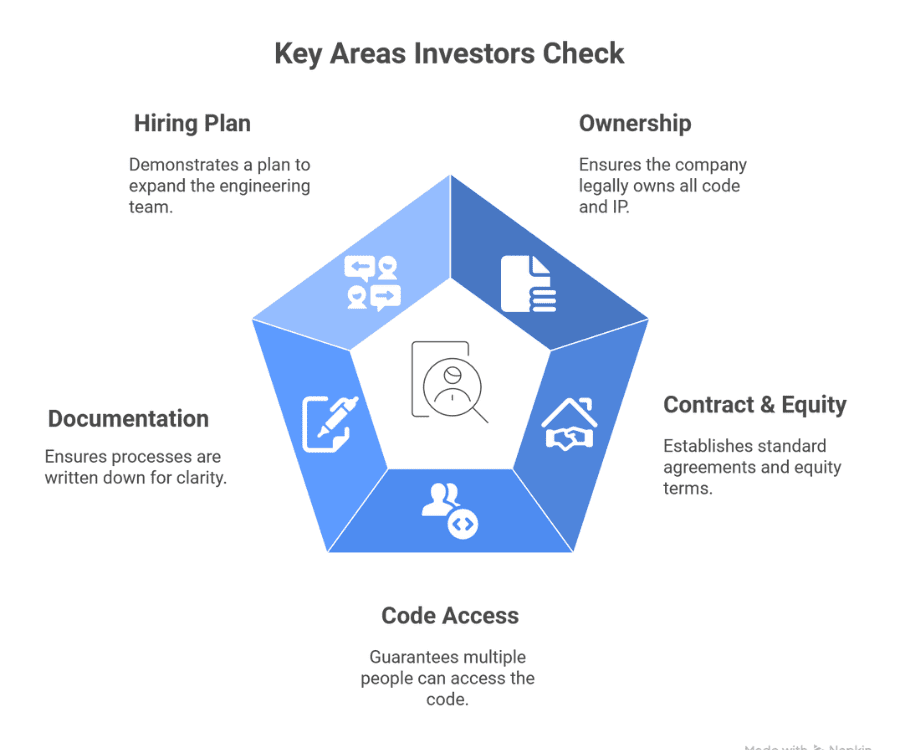
Here are the key areas investors look at.
Ownership
All code, designs, and algorithms belong to the company. Contractors sign agreements transferring IP. What investors want to hear: “All code belongs to the company. We have signed agreements from [CTO name] and every contractor. Our lawyer reviewed everything before fundraising.”
Contract and Equity
Standard employment agreement with confidentiality, non‑compete (where legal), and equity vesting over four years with a one‑year cliff. Equity should be meaningful (3–5%) but not co‑founder level. What investors want to hear: “Four‑year vest with one‑year cliff. Standard agreements. Investors in our last round saw [CTO name] as a key reason to invest.”
Code Access
Code lives in a company‑controlled system (e.g., GitHub), not on a single laptop. Multiple people have access, with review and documentation processes in place. What investors want to hear: “Our code is in GitHub under the company account. I have admin access, our CTO has access, and everything is documented.”
Documentation
System architecture, major decisions, and deployment processes are written down. If the CTO left, another engineer could get up to speed in a week. What investors want to hear: “We document major technical decisions and our deployment process. A competent engineer could get up to speed in a week.”
Hiring plan
The CTO won’t remain the only technical person in the startup as it scales. Recruiting plans are in place, with contacts ready. What investors want to hear: “After funding, we’re hiring two senior engineers in Q1. By year’s end, we’ll have five engineers, eliminating single‑person risk.”

Pitching as a non‑technical SaaS founder with a hired CTO can become your biggest strength. Investors don’t expect you to write code but to understand the business, show technical literacy, and prove that you and your CTO work as true partners.
The strategic advantage a non‑technical founder brings is clarity: you focus on market, customers, and growth, while your CTO ensures the technical foundation supports those goals. Together, you show investors that the company is resilient, scalable, and ready for product development.
The five steps in this article are practical SaaS founder advice: own your startup’s business side, learn enough tech to make smart decisions, demonstrate collaboration, frame the hired CTO as a deliberate choice, and prove that risks are managed.
Carefully curated content for resourceful Devs, CTOs, and PMs. No spam.