In 2026, a team of five can take an AI product from an idea to the App Store in 2 weeks. We did it twice this year, with EasySpk, a voice keyboard for iPhone, and GhostMinutes, an app that turns meetings into notes. AI made the building fast and cheap. Finding customers and the right price still took weeks of testing after launch.
Below: what AI changes when you start a startup and what stays the same, how to pick the right kind of AI idea, the trade-off between speed and cost, and a 30/60/90-day plan to launch.
What AI changes for a startup in 2026
You can ship in weeks
AI now writes a big share of startup code. In Y Combinator’s winter 2025 batch, a quarter of the startups had codebases that were 95% written by AI, according to YC managing partner Jared Friedman (TechCrunch). He added that these founders were highly technical and could have written the code themselves.
Our own numbers: EasySpk and GhostMinutes each reached the App Store 2 weeks after we started, with the name, brand and design made from scratch. IPOPBOOKS, a bookkeeping platform where AI helps sort bank transactions, went live 10 weeks after kickoff with a client portal, a workspace for bookkeepers and an admin panel.
AI tools are only part of that speed. The rest comes from a narrow first release, ready-made modules for sign-up, payments and admin, and a small team with few hand-offs.
Running AI costs far less than it did
The cost of running a model at a fixed quality level fell more than 280 times between November 2022 and October 2024 (Stanford AI Index 2025). Ideas that were too expensive to run two years ago can work now. Each request still costs something, though, and the bill grows with every user. More on that below.
You need fewer people to start
The share of new startups with a solo founder grew from 23.7% in 2019 to 36.3% in the first half of 2025, according to Carta, which links part of the rise to AI (Carta). Money hasn’t followed at the same pace. In 2024, solo founders started 30% of new companies but got only 14.7% of the cash raised in priced rounds.
What AI doesn’t change
You still need people who will pay
When building is cheap, it’s tempting to skip the boring part. Don’t. Poor product-market fit showed up in 43% of the VC-backed startups that shut down since 2023 (CB Insights). AI can’t tell you if people want your product. Our guide on how to validate a startup idea covers that step by step.
Someone still has to check the code
AI writes code fast, but a person has to make sure it’s right and safe. In a 2025 study by METR, 16 experienced open-source developers took 19% longer to finish real tasks with AI tools, while believing they’d been 20% faster (METR). Plan time for review even when AI writes most of the code.
A working demo is the easy part
An AI demo that works on ten examples can fail on the hundredth. Gartner predicted that at least 30% of generative AI projects would be dropped after the proof-of-concept stage by the end of 2025, because of poor data, weak risk controls, rising costs or unclear value (Gartner). Gartner was counting projects inside big companies, and a startup’s first AI product can stall for any of the same reasons.
Launch paperwork takes the same time
App Store review, a new Apple developer account and approval from a payment provider don’t move faster because you use AI. EasySpk and GhostMinutes went live on our Apple developer and Stripe accounts, so the founders didn’t have to wait for their own.
Getting noticed is harder
If anyone can build an app in two weeks, more people do, and rivals can copy your features faster. So the hard part moves from building to selling. You need to know exactly who buys and why they’d switch from what they use now.
AI-first product or a product with AI features?
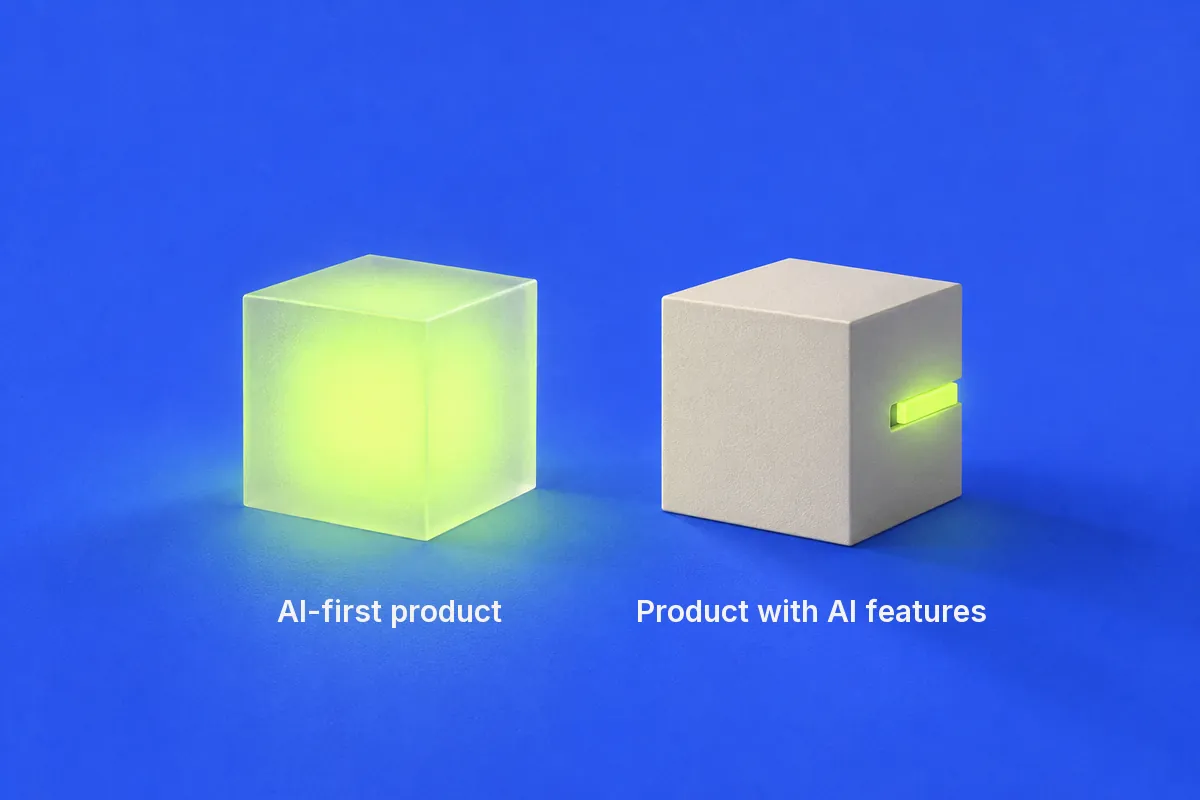
There are two kinds of AI startups, and they fail in different ways. Know which one you’re starting.
An AI-first product can’t exist without the AI. EasySpk turns speech into clean, ready-to-send text in any app on the iPhone. GhostMinutes turns a recording into a transcript with speaker names, a summary and a chat about the meeting. Take the AI out and nothing is left.
A product with AI features is a normal product where AI removes manual work. IPOPBOOKS does the books for small US businesses. For each bank transaction, AI suggests a category with a one-line reason, and a bookkeeper approves or fixes it. The AI never writes to the books on its own (IPOPBOOKS case study).
AI-first product
Product with AI features
Example
EasySpk, GhostMinutes
IPOPBOOKS
What you must prove
The AI result is good enough to pay for on its own
The product saves enough work that people switch to it
Main risk
A big company adds the same AI to a product people already use
The AI adds cost without adding enough value
What makes it hard to copy
Speed, quality and a brand in one narrow use
Your workflow, your data and the people who check the AI
How AI costs grow
With every request
They can shrink as the system learns from approvals
AI-first product vs a product with AI features
A quick test for an AI-first idea: if AI got ten times better tomorrow, would your product get better, or would a big company’s product make yours pointless? If it’s the second, pick a narrower group of customers, or a job the big products do badly.
Speed and cost: settle the trade-off before you build
Every AI request costs money and makes the user wait, and users feel the wait quickly. Jakob Nielsen’s research puts the limit for keeping someone’s flow of thought at about 1 second. After about 10 seconds, people stop paying attention (Nielsen Norman Group).
EasySpk: speed was the product
People use a voice keyboard to save time, so a slow answer kills the point. We chose the AI setup for response time and cost per request, not only for the quality of the text. At the start, processing took up to 3 seconds. After tuning, it takes up to 1 second, and a plain transcription comes back in about half a second. The app got 1,000+ downloads in its first days (EasySpk case study).
GhostMinutes: pay for servers only while they work
Transcription needs expensive GPU servers, and an idle server costs as much as a busy one. So a server starts only when a file comes in and shuts down when the job is done. The founder pays for server time only while audio is being processed (GhostMinutes case study).
IPOPBOOKS: fewer AI calls over time
The platform remembers every approved category. The next charge from the same merchant gets the same category at once, with no AI call. So each client needs fewer AI calls the longer they stay.
Before you sign with any team, ask three questions. What does one request cost? How long does the user wait? What happens when the AI is wrong? Our guide on what an AI app costs goes deeper into running costs.
A realistic 30/60/90-day plan
Ninety days won’t get you product-market fit. They can get you a live product, paying users, real usage numbers and a clear next step.
Days
Goal
What you have at the end
1-30
Prove people want it
20+ interviews, a landing page result, first pre-sales, AI results tested by hand
31-60
Build and launch a first release
A live app that does one job, with payments on and first users in
61-90
Learn and decide
Weekly releases, price tests, numbers on who stays and what the AI costs per user
The first 90 days of an AI startup
Days 1-30: prove people want it
Talk to at least 20 people who have the problem, put up a landing page and try to pre-sell. Run interviews and the landing page at the same time and you’ll have a first read within a month.
Test the AI part by hand as well. Collect 20 real examples from future customers, run them through off-the-shelf AI tools, check the results and show them to the people who gave you the examples. If the result doesn’t impress them when you make it by hand, software won’t fix that.
Days 31-60: build and launch a first release
Keep the first release to one job for one type of user, and use ready-made parts for sign-up and payments. With us, an MVP costs $5,000 to $15,000 and takes 2 to 4 weeks, and EasySpk and GhostMinutes each took 2. Our guides on what an MVP costs and how long it takes to build an app show where the money and weeks go.
Plan for the paperwork too. Apple developer and payment accounts can take days to approve, so apply in the first week.
Days 61-90: learn and decide
Switch to 1-week sprints. Each week, fix the spot where most users drop off, make the AI faster or cheaper, and test one thing about price.
GhostMinutes did this. The web app came a week after the iOS app. Then came a couple of weeks of feature and pricing tests with the founder’s marketing team: landing pages for different audiences, a quiz that suggests a plan, four plans and one-time packs of minutes. The product reached $1,500 in monthly recurring revenue.
Track three numbers: how many sign-ups get to the first useful result, how many come back the next week, and what the AI costs per active user. At day 90, put the next month into the audience that pays and stays, and cut what nobody uses.
Then decide how to fund the next stage. Investors are putting money into AI: AI companies took about half of all US pre-seed dollars on Carta in the first half of 2026 (Carta). They’ll still ask for numbers, and by now you have them.
Who builds it if you’re not technical?
You can build it yourself with AI coding tools, hire a freelancer, hire an agency, or bring in a technical partner. AI coding tools are fine for a clickable demo. Once you need an App Store app with payments and an AI setup that’s cheap to run, you need someone who has shipped one before.
A fractional CTO gives you that person part-time: 10, 20 or 40 hours a month at $39 to $55 an hour. We also work as a fractional tech co-founder, leading the technical side and building the product. In a co-founder deal, part of our fee can be a small equity stake, and the rest is paid in cash.
FAQ
How do you start an AI startup with no technical background?
Start with the problem, not the technology. Talk to 20 or more people who have it, test the AI part by hand on real examples, and try to pre-sell. Then bring in a technical partner or a fractional CTO to build a narrow first release. AI coding tools are fine for a demo, but an App Store launch with payments needs someone who has done it before.
How much does it cost to start an AI startup?
Testing the idea costs mostly your time and a small ad budget. A first release with us costs $5,000 to $15,000 and takes 2 to 4 weeks. After launch, you pay for AI requests and servers, which grow with your users, plus the next releases.
Should I build my own AI model?
Usually not at the start. Ready-made models are enough to test the idea and launch. Your own or tuned models make sense later, when speed, cost per request or quality becomes the thing that sets your product apart.
Can AI build my whole app?
AI can write much of the code, and at many startups it already does. Someone still has to decide what to build, check the code, connect payments, pass App Store review and fix what breaks. In a 2025 study, experienced developers worked slower with AI tools on real tasks, so the gain depends on who uses them.
How long does it take to launch an AI product?
A narrow first release can take 2 weeks. EasySpk and GhostMinutes each reached the App Store in 2 weeks. A bigger platform takes longer: IPOPBOOKS, with a client portal, a bookkeeper workspace and an admin panel, went live in 10 weeks.
How do you keep AI costs down after launch?
Pick the AI setup for its price per request and its speed, not only its quality. Run expensive servers only while there’s work. Save results the system can reuse, so repeat cases need no AI call. Check the AI cost per active user every week.
Plan your first 90 days
Describe your AI product in a few sentences. Our AI estimate turns it into a scope, a budget range and a timeline in about four minutes.