Your Vibe-Coded App Works. Is It Ready for Real Users?
Nine things to check before strangers sign up and pay, how to test each one yourself, and how to decide whether to keep, fix or rebuild what the AI wrote.
Early‑stage SaaS pricing is almost always a guess. Most founders pick a low number just to get their first few customers. But as you move post‑MVP, that early ‘founder logic’ starts to break.
Whether it was Slack’s $6.67 pricing strategy or Notion’s flat fee, every successful startup eventually hits a wall where support costs stay high, and revenue remains flat. This guide explains how to spot the four triggers that signal it is time to build scalable pricing strategies that match the real value of your SaaS product.

In the early days, pricing often comes from founder logic. You rely on instinct, want the product to feel easy to try, and set the price lower than competitors. It works because it removes friction and brings in early users.
Founder logic works at launch because it removes barriers. It brings in early users and gives you the feedback you need.
The problem comes later, when usage grows, and costs rise with it. Infrastructure, support, and development get heavier, but the early price stays the same. What worked at the start becomes harder to maintain.
At some point, your prices have to match the value you deliver and the cost of supporting it. Many SaaS founders struggle here because early pricing sets expectations. A customer who joined at $9 doesn’t suddenly see the product as a $29 offer; they see the same $9 product that now costs more.
Custom software development for startups is the fastest way to market.
Slack launched its Standard plan at $6.67 per user per month. Slack never explained the exact reason for that number, but many analysts noted it felt cheaper than a clean $7 or $8, which helped Slack spread among small teams.
As Slack grew and started serving larger organizations, that early price no longer fit the value they were providing. They introduced a new structure, including Enterprise Grid, to better serve bigger customers. The original per‑seat rate wasn’t built for that shift.
The takeaway: Early pricing shapes how customers think about your product. If your first price signals “affordable team tool,” you may need to rethink your structure as your value grows.
If you recognize two or more of these triggers, it’s a good sign that your SaaS pricing model needs attention. Waiting usually makes the shift harder.
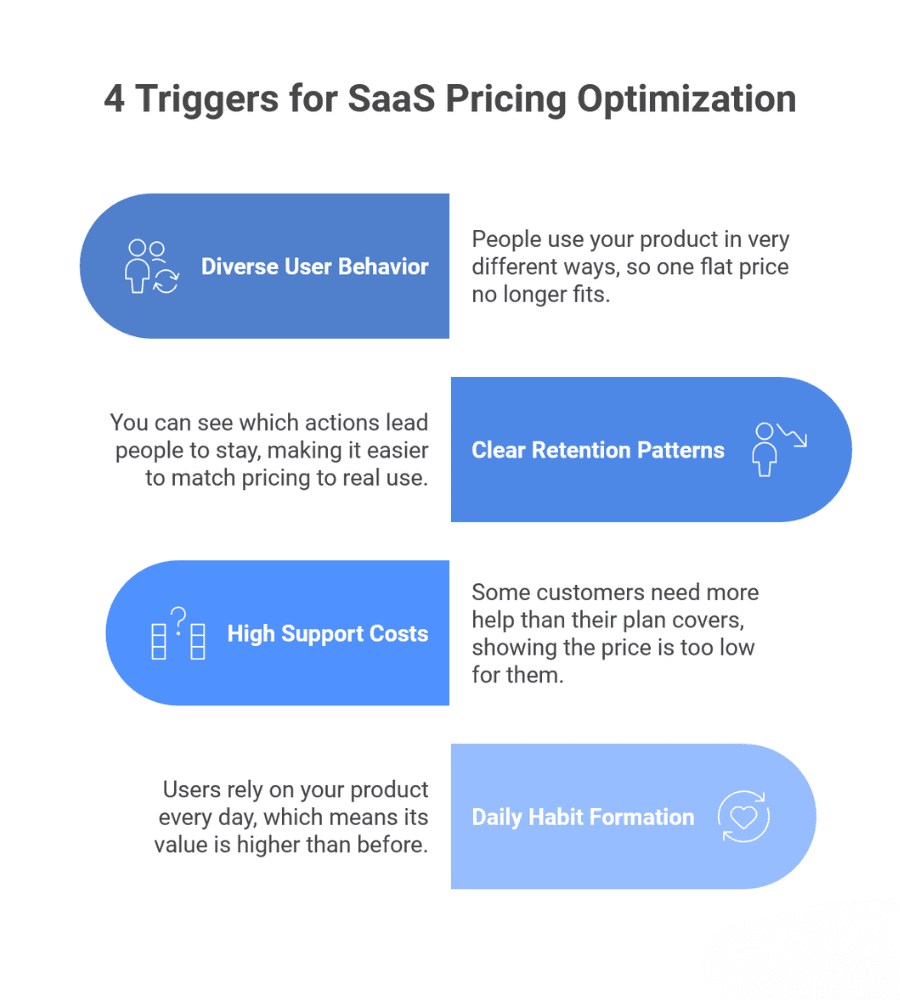
As your product grows, your users stop behaving like one group. Some log in once in a while. Others run key parts of their business on your platform. Some use one feature lightly, while others rely on several features together.
Once these differences become clear, a flat price starts to feel off. A casual user and a power user shouldn’t pay the same amount when the value they get — and the cost to support them — are so different.
Notion started out as a tool for personal productivity that cost $4 a month. But over time, it became clear that teams were getting the most benefit from it, not just individual users.
Companies were using Notion as their wiki, project manager, database, and shared workspace. Entire workflows were being built inside the product, far beyond the original “personal notebook” idea.
As more teams adopted Notion, the early pricing no longer fit how the product was being used. To match the value it delivered to larger groups, Notion introduced team‑focused plans ranging from $8 to $18+ per user. This shift reflected how deeply teams depended on the product.
When one group of users relies on your product more than others, a simple or flat model eventually stops working. As you learn how different customers use your product, you need to adjust your model accordingly.
| Related articles: SaaS Financial Models: Essential Metrics for B2B Founders The Ultimate Guide to Building a B2B SaaS Financial Model for Startup Founders |
In the early days of any SaaS tool, everything feels uncertain. You don’t know who will stay, who will upgrade, or why people leave. Most decisions are guesses.
Over time, patterns start to appear. Users who complete a certain action in their first week tend to stick around. Teams with more than five members rarely churn. Users who connect an integration convert to paid at a higher rate.
Once you can clearly see these patterns, you’re no longer guessing. You understand what drives long‑term value, and that gives you the information you need to adjust how much you charge. At this stage, pricing becomes less about intuition and more about matching what you charge to the behaviors that signal real engagement.
Some customers eventually need far more help than their subscription covers. A user paying $10 a month might send enough support requests to cost you more than that in time alone. When this becomes a pattern, it’s a sign your pricing no longer reflects the real cost of serving your most demanding users.
A quick way to check is to look through recent support tickets. Find the customers who need the most help, then compare that to what they’re paying. If the numbers feel out of balance, the situation is obvious.
As your SaaS product grows, you start to see steady, repeated use. People often come back to your tool, build routines around it, and connect it to other instruments. At that point, your solution becomes part of their daily work, and losing it would cause disruption.
When a tool reaches this level of regular use, the value it provides is very different from the early trial phase. Reliability matters more, and the product becomes a core part of how people get things done.
If users rely on your product to run their processes and would face real effort or cost to switch away, that’s a clear sign it has become essential. Prices eventually need to reflect that level of dependence.
Most founders know their early numbers won’t last, but they’re not sure how to replace them with something stronger. A simple SaaS pricing framework helps you move from guesswork to a structure that can grow with your product and your customers.
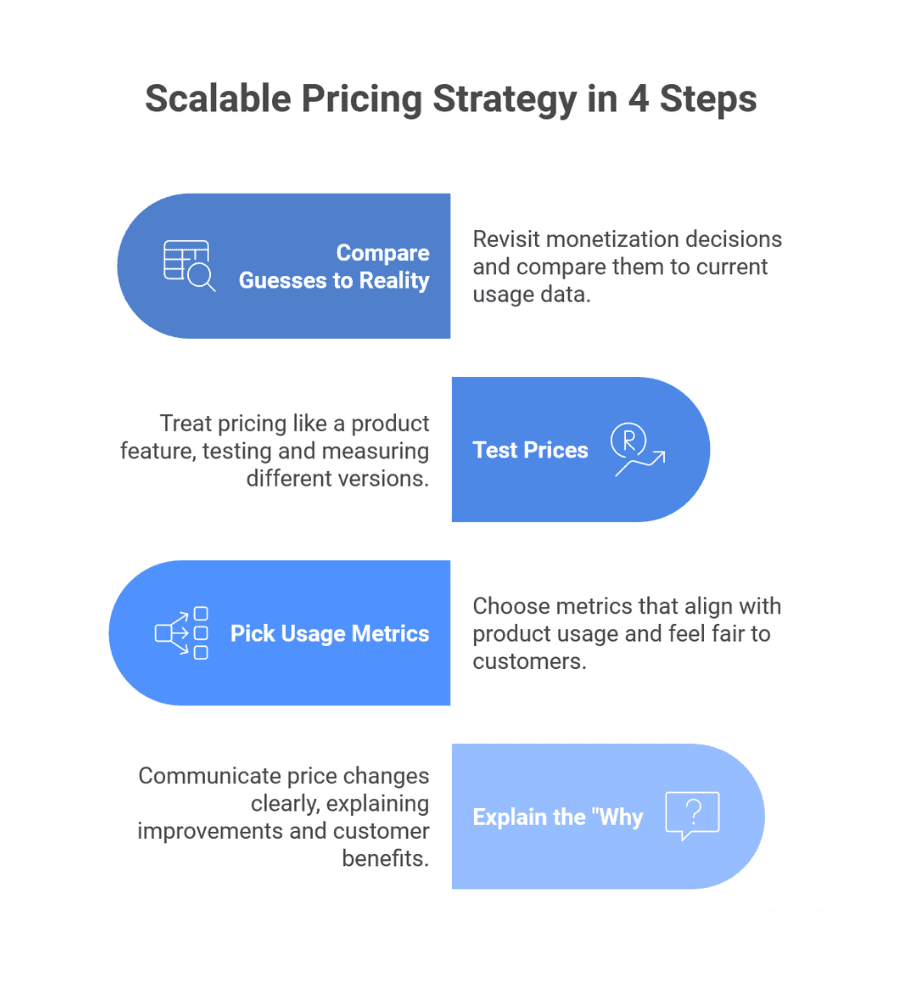
Start by revisiting your original monetization decisions. Write down what you believed people would pay for when you launched. Then look at your current usage data and see what customers actually use and value today.
The difference between what you thought would happen and what’s actually going on is often where you’ll find new opportunities.
Instead of guessing what should go into their paid tiers, Canva studied how “Pro” users behaved compared to free users. They found that professional designers weren’t upgrading for things like extra storage. They upgraded for features that helped them work at scale — Brand Kits, Magic Resize, and tools that kept design work consistent across projects.
Canva moved away from instinct and started segmenting users based on real professional needs. They identified which features delivered the most value to their highest‑value users and built their model around access to those capabilities.
💡 Do the same. Look at which features your most committed customers use that casual users rarely touch. Those areas often point directly to where your premium tiers should focus.
| Related articles: Building A SaaS Business With No Funding: A Practical 0 To 1 Guide |
SaaS pricing works best when you treat it like a product feature — something you test, measure, and adjust as you learn more about your users.
New cohorts, different tier setups, and small experiments can show you which versions lead to better conversion and healthier revenue per customer. The goal is to understand what people value and how different groups respond to different options.
Airtable started with a free plan so they could see how people used the product before deciding on a pricing model. Once they noticed which features really got people engaged, like API access, heavy database use, and advanced automations, they moved those features into the more expensive plans.
They made these changes because the data showed that some features were really valuable to certain users, and they based their strategy on that.
💡 Take the same approach. Test how much you charge to see how different customers behave. Try new structures with fresh users. Let the data show you which models fit your product’s value and which ones don’t.
Flat pricing is simple, but it rarely fits businesses where customers use the product in very different ways. Usage‑based metrics help your revenue grow in line with how people actually use the product.
Common usage metrics:
The goal is to choose metrics that make sense for your product and feel fair to customers. A collaboration tool often works well with per‑seat pricing. A database platform usually fits better with per‑record or storage‑based models.
💡 Usage‑linked models also solve an important problem: they let customers start small and increase spending naturally as they get more value. There’s no big upfront commitment. What they pay grows with usage, not before.
When you raise prices, the way you communicate the change matters. Customers respond much better when they understand what’s improved, what they’re getting, and why the new plans support the experience they rely on.
The weakest approach is blaming rising costs. It feels generic and doesn’t help customers see the value behind the decision.
A clearer approach is to explain what you’ve invested in (new features, stronger infrastructure, better support) and how those improvements help customers achieve specific outcomes. When people see the link between the work you’ve done and the price they pay, the change feels more reasonable.
💡 There’s a simple idea to keep in mind: pricing reflects confidence. Very low prices often signal uncertainty about the product’s value. Higher prices signal that you understand the impact your product has and that you stand behind it. Customers notice this more than most founders expect.
One of the biggest worries founders have about raising prices is the fear that everyone will leave. In practice, that rarely happens. Most SaaS companies see a small drop in users, usually the group that was only there because the product was inexpensive, while revenue from the remaining customers increases. The users who stay are the ones who rely on the product and see real value in it.
Some customers eventually cost more than they bring in. When that happens, adjusting who you serve is part of growing a healthy business. The transition just needs to be handled carefully. Here are the main approaches.
Keep early adopters on their original plans indefinitely. This builds goodwill and avoids friction, but it also creates a more complex pricing structure that becomes harder to manage as you grow.
Use this when your early adopter group is small, and their loyalty or advocacy is more valuable than the extra revenue.
Give existing customers six to twelve months at the old rate, then move everyone to the new model. This gives people time to adjust while keeping your long‑term pricing consistent.
Use this when you have a larger customer base and need a unified structure to scale.
Keep the old plan in place but introduce a new one that clearly offers more. Instead of forcing customers off their current plans, you give them a strong reason to upgrade on their own.
Use this when you’re adding meaningful new features or capabilities that naturally support a higher price.
The important thing is not to let fear delay the change. The longer you wait, the harder the transition becomes. Focus on the customers who rely on your product and see its value — they’re the foundation of a sustainable business.
Pricing changes can feel uncomfortable, but they’re part of running a product that’s growing and being used in different ways. As your SaaS develops, the value people get from it shifts, and your prices need to match that. Updating your model is one of the simplest ways to protect long‑term product viability and keep the business strong enough to support the customers who depend on you.
When you watch how people use your product, run small tests, and explain your decisions clearly, the right customers stay with you. They’re the ones who see the value and want the product to keep improving. That’s the group you build around. Treat your revenue model the same way you treat your product: test numbers you charge like a feature, learn from the results, and adjust as you go. SaaS pricing optimization works best when you understand what you deliver and charge in a way that lets you keep delivering it.
A pricing change can require billing, packaging and onboarding changes as well as buyer research. Our startup development service and the Guestroom case are delivery references for discussing that scope, not evidence of the price your customers will accept. Explore software development for startups and the Guestroom case study.
Discuss the scope of your next pricing experiment
Start with an AI-assisted project brief covering scope, budget, market assumptions and risks. Review its hypotheses before making a commitment.
Carefully curated content for resourceful Devs, CTOs, and PMs. No spam.