Your Vibe-Coded App Works. Is It Ready for Real Users?
Nine things to check before strangers sign up and pay, how to test each one yourself, and how to decide whether to keep, fix or rebuild what the AI wrote.
Most startup founders know this scenario. You have an idea and maybe $10K in savings. No investors or runway yet. If you waste time or money building the wrong thing, you’re done before you start.
Learning how to build a SaaS with no funding means making smart trade-offs. You need to validate a real problem, build the smallest possible solution, get it in front of users fast, and prove someone will pay for it. That’s how you go from zero to fundable.
This guide shows you how to build a SaaS MVP on a budget without cutting corners that matter. You’ll learn what to skip, where to spend your limited resources, and how to validate your SaaS idea without investors writing checks first. Every decision protects your runway while moving you closer to proof.
Who this guide is for: Pre-money founders at the 0-to-1 stage. You have a business idea, limited resources, and need to prove your concept to attract first investors. You don’t have product-market fit or revenue yet.

Many founders understandably think the SaaS market crashed. In reality, it’s just matured. Investors now fund discipline, not dreams. And for pre-money founders, this creates both pressure and opportunity.
In 2023, enterprise SaaS deals dropped by roughly a third in both count and value. The easy capital that fueled “growth at any cost” is gone. Yet SaaS remains one of the few categories still attracting consistent funding — $9.7 billion was raised in Q2 2025 alone, nearly double what the sector pulled two years earlier (Fund Society). The money is still there; it’s just harder to earn.
This is good news if you’re starting now. Less competition means buyers notice real solutions. Companies cutting costs want tools that save money, not nice-to-haves. Your job as a pre-money founder is simpler: find one painful problem, build the minimum solution, and prove three people will pay for it.
Investors want to see three things before they write a check:
At this point, you are not yet proving business metrics, but showing you know how to figure things out without wasting money. That’s the global shift.
When you’re a SaaS startup on a budget, every dollar is naturally a bet. While many fresh founders think that spending too much is the worst they can do, the biggest mistake is spending on the wrong things. Here’s what actually derails founders at the 0-to-1 stage.
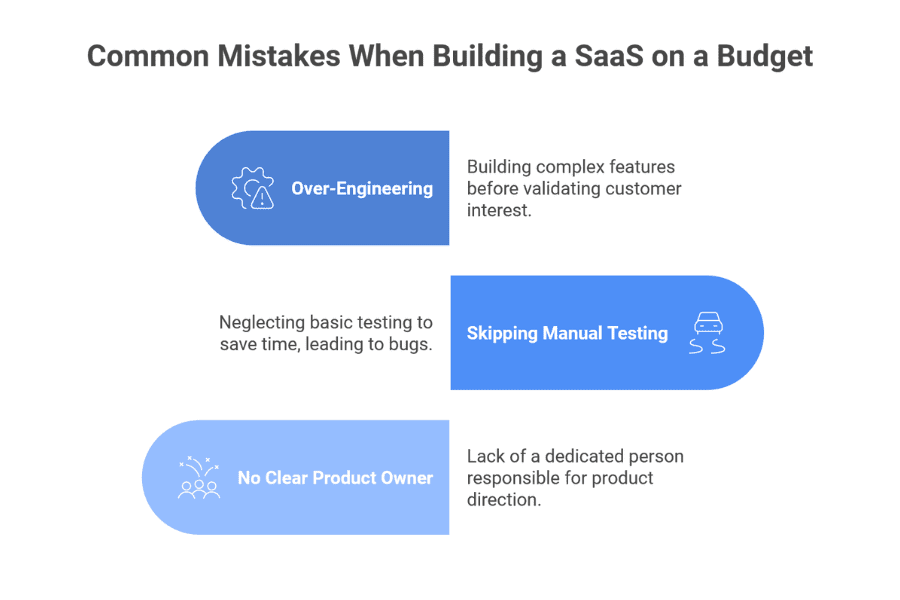
Does “We’ll build it right from the start” sound responsible? It’s actually the fastest way to die.
At the 0-to-1 stage, architecture, scalability, and clean code don’t matter. The only thing that counts is whether customers care about your solution. You can’t know that without putting something in their hands.
One founder spent four months building a “scalable microservices architecture” for a project management tool. They launched with zero users because they never talked to customers during the build. Meanwhile, a competitor shipped a messy Bubble app in two weeks, got 20 signups, learned the core feature was wrong, pivoted, and had paying users by month two.
Critical note: Once you have product-market fit and paying customers, this advice flips. Then you invest in architecture. But most founders never reach that stage because they optimize too early. Technical debt is only expensive if you survive long enough for it to matter.
Contrary to popular belief, you don’t yet need automated tests and a legendary QA team. Instead, create a thought-through checklist and 20 minutes before every demo.
While on other startup stages bugs indicate technical problems, at the beginning, they become trust killers. If your demo breaks during a customer call, you lose credibility you can’t afford to lose. But over-investing in testing infrastructure burns the runway you also can’t afford.
One founder kept a simple Google Doc: “Test before demo.” It had four items: Sign up, Load data, Run report, and Log out. That’s it. They tested it themselves every Friday before the weekend outreach and had zero failed demos in 12 weeks.
Automated tests come later — post-seed, maybe Round A. Right now, your job is not to embarrass yourself in front of potential customers.
When you want to build SaaS with limited resources, solo or in a tiny team, everyone does everything. That’s fine until it isn’t. Without one person owning “what gets built and why,” you end up with feature soup. While having a product manager is great, what you really need is product discipline.
A two-person startup team building an expense tool had a rule: only build features mentioned by three different customers in recorded calls. Everything else went in “Parked.” They shipped fewer features, but each one landed.
At 0-to-1, a strong product owner isn’t overhead but the difference between random activity and purposeful progress.
It still comes as a surprise to many first-time founders, but you don’t need a big budget to test an idea. For SaaS product development without investors, you need focus. Every decision is simple: does this help me get customer feedback faster, or does it slow me down? If it slows you down, cut it.
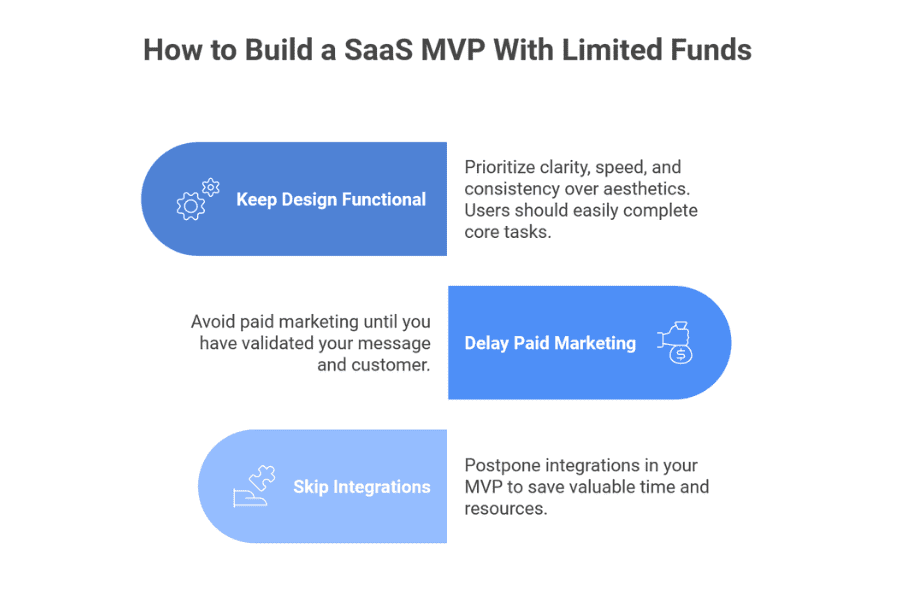
Leave the idea of a Dribbble portfolio piece for later stages, when you can afford to hire the best designer in your area. Now you need three things: clarity, speed, and consistency. Users should finish the core task without confusion. That’s the bar.
Exception: If you’re entering a crowded market where UX is the differentiator — neobanking, consumer social tools, design software — then design IS your product. Invest accordingly. For most B2B SaaS at the MVP stage, functional beats pretty.
Real example: A data compliance tool startup launched with a three-screen app: upload file, see results, download report. No logo animations or custom illustrations, but simply grey, blue, and white. They used Tailwin’s default components. The first paying customer signed in week five because the tool solved a painful manual process, while design had nothing to do with it.
Test your design with one question: Can a new user complete the core job in under five minutes without asking for help? If yes, you’re ready to show customers.
Do not run ads, pay for clicks, or hire a growth marketer. Not yet.
Paid marketing without a validated message is pouring money into a hole. You don’t know what convert or even who your customer is. You’re guessing, and guesses cost $3–5 per click.
Real story: A founder building QA automation found their first 100 users by answering questions in two Slack groups for test engineers. They posted short videos showing “here’s the manual way, here’s our way.” Zero ad spend. They collected 60 emails in six weeks, ran pilots with 12 teams, and signed three paid contracts before raising a dime.
Forget about clicks and track conversations. Your goal is 10 deep customer interviews where someone says, “I would pay for this.” Once you have that, then you can think about scaling with ads. Not before.
In a typical SaaS MVP guide for founders, every integration looks simple on paper. In reality, it’s API changes, permission errors, version mismatches, edge cases, and ongoing support. Integrations drain time you cannot afford to lose.
At 0-to-1, default to zero integrations. Use these instead:
One compliance SaaS startup planned five payroll system integrations before launch. Instead, they shipped an SFTP drop folder and CSV import. Saved eight weeks. Turned two pilots into paid contracts. Added native integrations only after six customers asked for the same one.
Build integrations when:
Before that, integrations are a distraction.
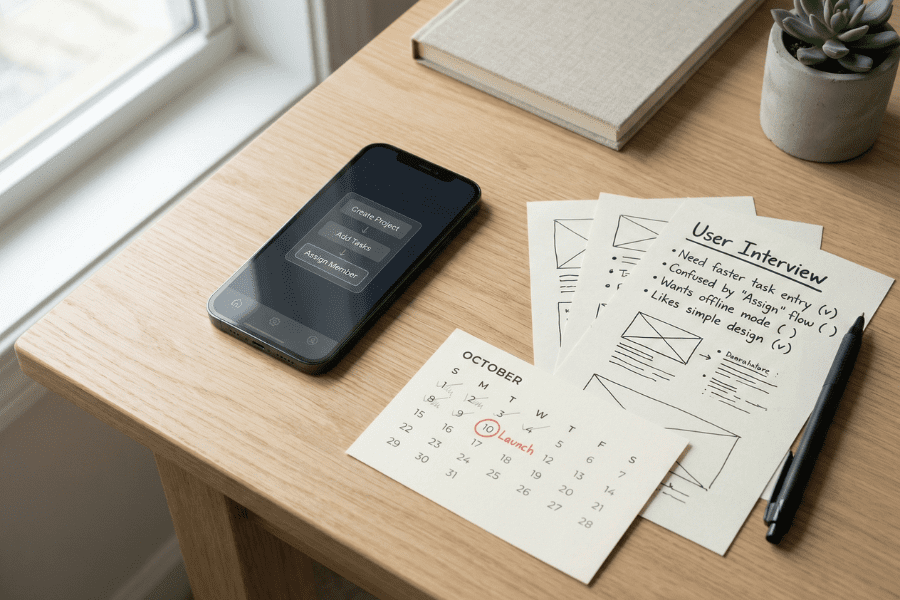
Building a SaaS with no funding means doing less, but doing it right. You win by moving fast, learning constantly, and spending only where it gets you closer to proof.
Your 30-day checklist to build a fundable SaaS:
You’re not yet building a business but gathering evidence that the problem is real and your startup has the solution people will pay for. Investors fund evidence. That’s how you validate a SaaS idea early and turn limited resources into momentum when building early SaaS products from scratch.
Carefully curated content for resourceful Devs, CTOs, and PMs. No spam.